
How The Government Made
The Gasoline More Effective
In the late 80s, the California government set a mandate for an emissions standard for gasoline sold in California. And gave oil companies a maximum of 2 years to comply and come up with a solution.
It was like saying: "if you want to do business in California and sell your gasoline, you're going to have to do something to the gas to make it burn more effectively and cause less pollution, if you don't, we won't let you do business in California."
Oil
and gasoline companies, like Shell and Chevron knew very well that
there was an easy way to do this. The down-side was... if they made the
gasoline burn more effectively... it would increase your car's mileage.
That's good news for you and I... since a higher
mileage means less money spent on gas... Not so good news for the oil
companies, they lose money.
So they had to increase the fuel efficiency only enough for it to meet the new emissions standards in California, and not enough to lose them money. - they were successful.
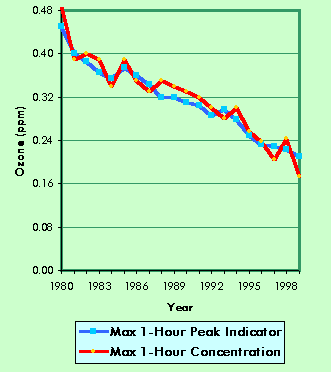 Smog Graph for California from 1980-1998
Not many people know about this 'insider secret' that's in most gasoline today.
The good news is... today, you can tap into the same technology that the oil companies used in the 1980s to comply with the new pollution standards, safely use it in your car to increase your engine life - and get an increase in mileage of 19% or more - which can save you 90¢ per gallon or more with today's prices. Thousands of people in America are doing it on a daily basis.
How and Why Your Engine Wastes
20% Of Your Gas Out Your Tail-Pipe
Do you own a car? Go in the garage or drive-way right now, and run your finger around the inside edge of the tail-pipe.
What you'll see now is your finger coated with a dark black smudge.This stuff on your finger is wasted gas, un-burnt by your engine, and your wasted money.
Most people don't know that the average car engine is only 17% to 23% efficient, because of energy conversion inside the engine,and because 20% of the gas you buy usually goes right out your tail-pipe as carbon waste.
Just think of it this way: If you spend $40 to fill up your car, $8 of that money goes right out of your tail-pipe.
Why does this happen?
It's a little bit of engine mechanics - However, even if you don't know anything about engines, it's pretty easy to picture:
Just like most living things needs oxygen to breathe, fire needs oxygen
to burn, and gasoline needs oxygen to explode powerfully enough to move
a car.
Your engine doesn't actually use gasoline. It uses "gasoline vapor". When you pour gasoline into your gas tank, it goes in there in liquid form. Before you engine can use the gasoline, it has to turn it into gas-vapor.
When the engine vaporizes the gasoline, it mixes the gasoline with oxygen to create a rich powerful oxygen/gasoline mixture.This is the job of the fuel injection system in your car, or the carburetor (if you drive an older car)
What engine experts and oil companies have known for years is that only about 30-50% of the gas you put in your car gets properly vaporized for ignition.
A big chunk 15-20% of gasoline is un-burnt due to the size of the
gasoline molecules, this comes out of your engine as smog and pollution.
Even more energy is wasted because of the wear-and tear in the engine,
engine energy HEAT loss, and cooling energy, which all adds up to about
80% in wasted energy.
What this means is that whenever you pump up
your gas, it's like getting ripped off twice... Once for gas prices of
over 3.00 per gallon, and then again, because not all that gas is
actually used properly...
Think about it... 15% to 20%
of the gas you buy comes out of your tail-pipe as waste... that's like
pouring one fifth of the gas you buy on the ground when you fill
up your car. This is why we have such much smog and pollution in the
air today. This smog and pollution results in health problems, like
asthma, bronchitis and cancer, as well as many other environmental
concerns, especially in countries where leaded fuel is still used.
How The Oil Companies 'Solved' The Problem
Have you ever tried to get from point A to B through a crowd FULL of people shoulder to shoulder?
It's the same with gasoline. It clumps together, because it's a very rich, and heavy compound. It's like a bunch of marbles stuck together very tightly.
What the oil companies did was find a way to spread the gasoline particles out, so they have more space between them, like popcorn.This lets air and oxygen between the gas particles, and makes them burn better.
When you drive up to a gas station and see the different grades of gasoline... Basic, Premium, Plus... etc... These are just different grades of molecule spacing. They're making the gas more effective, and charging you more money for it!
It's also much better for your engine parts as the gasoline burns more evenly and creates less wear-and-tear on the motor.
Gasoline BEFORE Treatment
|
Gasoline AFTER Treatment
|


Long story short: Their idea worked, this is commonly used in gasoline today, and why the smog levels in California have dropped since the 1980s dramatically... so how does this help you save on gas today?
Why Most Gas Savers Are A
Total Rip Off
Imagine there was a legal, perfectly safe and natural way you could use the same technology the oil companies use to make premium fuel, and you could use it anytime to make the gas you buy for your car super effective.
It would save 7% to 19% or more on gas costs. Double your engine life and reduce dangerous pollution causing emissions by a land-slide.
It sounds too good be true... And unfortunately, because of a few rotten apples - it is a total scam for 90% of people who try such products.
They're called "fuel additives." You might have heard of someone buying a bottle of some weird concoction only to waste their money finding out it doesn't work.
A lot of companies tried to
break into the "gas saving market" by creating cheap substitutes for
real gas saver formulas to feed on naive consumers.
They're kind of like cheap imitations of coca-cola. Because to make an actual gas saver, ready for public use, you need E.P.A registration and laboratory testing results, to even put a product like this on the shelves.
(* E.P.A stands for Environment Protection Agency)
An average E.P.A test phase takes 1 year or longer, and will cost a company close to $1,000,000.00 dollars for the laboratory time, staff, equipment, government testing, patents, shipping certification
Not to mention, you need to seriously have the real deal, a real formula that works on science not myth, fantasy or mistruths, to pass the testing phase, here's why:
The Type Of Testing That Was Involved
It is easy to get a product on the shelves of retail stores if you're selling widgets or stuffed animals. However, if you're selling consumable products that go inside your car, it's a much different story:
As you can imagine, before anything is done or added to the gas in your car - it would have to be tested on numerous vehicles under many different conditions in controlled laboratory experiments.
#1. It has to be environmentally safe to not cause more damage than it produces benefits.
#2. It has to be tested with all types of engines to make sure its safe and doesn't damage engine components in anyway.
#3. Such a product would have to pass about 200 different tests, and if it failed 1 of them, there would be a panel of inquires just for that one problem until it is solved. If it didn't, the product would NEVER hit the shelves.
The 'Fake' Alcohol Based Gas Saver
Additives In Retail Stores Today
Obviously, few people will invest this kind of money to accomplish such a thing, with no guarantee of profit and a highly skeptical market-place.
So what do they do? What are these so called gas saver liquid additives in automotive retail stores? The label claims to "increase horsepower, get higher mileage", here's how they work:
These products aren't actually gas savers, but "Super-charged fuel in a small bottle." Because they are petroleum based, or alcohol based.
Why do they sell it? Because it's cheap to make:
Since Petroleum(gasoline) and Alcohol are already approved substances by the E.P.A, they don't have to go through lab testing to be put on the market. So its dirt cheap and easy for someone to make such a product, ship it off in bulk to retail stores, and hope make some profit off curious and un-suspecting car owners.
Why are they still on the shelves?
The idea behind these additives is to excite the gasoline molecules and make them burn really fast . As a result, you might feel a kick in the horse-power, your emissions go down a little. If someone is naive enough, they keep buying bottles of this stuff.
Does this save you any money in the long term?... No. Because you have to use a whole bottle of it, usually at $20 per bottle, per each tank. Hmm, buy $40 of gas, or ($40 + $20) for some toxic gas saver? I'd rather take the gas by itself.
